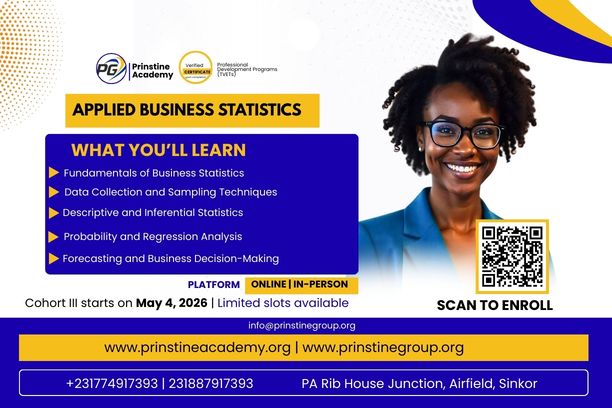
This 10-week course provides an in-depth understanding of Applied Business Statistics. The course introduces key concepts such as data collection methods, descriptive statistics, probability theory, random variables, sampling techniques, hypothesis testing, correlation and regression analysis, time series analysis, and decision-making under uncertainty. Students gain practical experience in organizing, analyzing, and interpreting business data to support strategic planning and operational efficiency.
Throughout the course, learners develop hands-on skills in using statistical tools and software to summarize data, construct charts and tables, calculate measures of central tendency and dispersion, and apply probability distributions to real-world business problems. Emphasis is placed on interpreting statistical results accurately and communicating findings clearly to support managerial decisions. Students also explore forecasting techniques, trend analysis, and risk assessment to improve business performance and competitiveness.
By the end of the course, learners will be able to confidently analyze and interpret quantitative data, apply statistical models to solve business problems, evaluate risks using probability concepts, and make evidence-based decisions that enhance organizational effectiveness and strategic growth.